





When choosing a backpack, storage capacity, comfort and features are usually our main criteria, and that is enough.
But in some cases, you may wonder which backpack to choose for your build?
At RayonRando, we are regularly asked which backpack suits a short hiker, or an average-height hiker looking for a high-capacity backpack. Several questions arise:
- Are the backpack's dimensions suited to my back length?
- Which backpack should you choose if you are short?
- How do you choose a women's backpack?
- Could a high-capacity backpack be too bulky for my build?
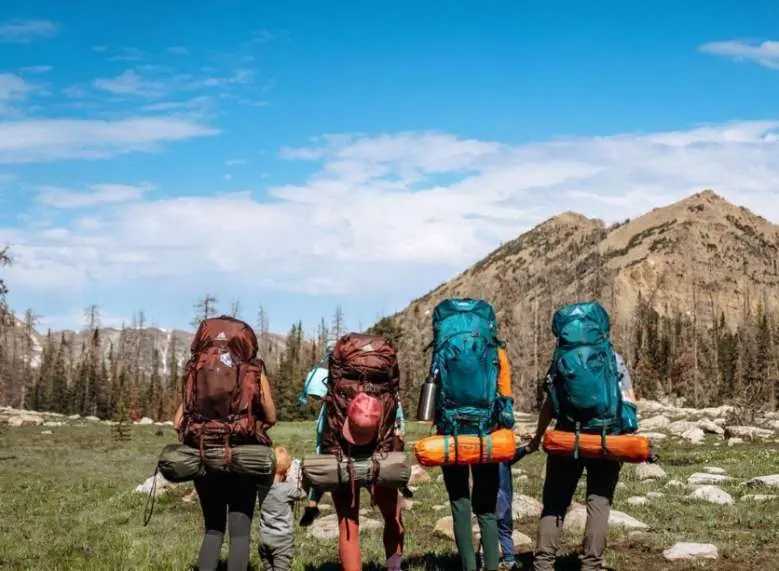
A backpack that suits your size matters for two reasons:
- Carrying comfort: once properly adjusted, the back, hip belt and shoulder straps must provide good stability and transfer the load onto your hips without pulling on your shoulders or hurting your back. You should feel the weight as little as possible.
- Freedom of movement: the backpack should move with you rather than restrict you, whether you are walking, turning your head or sometimes using your hands for support. It must preserve your balance despite the weight you carry.
At RayonRando, we help you check that your backpack suits your size using 2 criteria:
- The pack's overall height;
- The wearer's back length that the pack accommodates.
The pack's overall height:
We have measured the height of all our backpacks, empty, using a measuring stand.
- This measurement will help you confirm your choice if you are short or have a short back. If the empty pack reaches headrest height, it may get in the way during use.
- This also matters for people of average height who want a high-capacity backpack. We sometimes have women looking for a backpack of 60 L or more. This capacity does not suit every body shape.
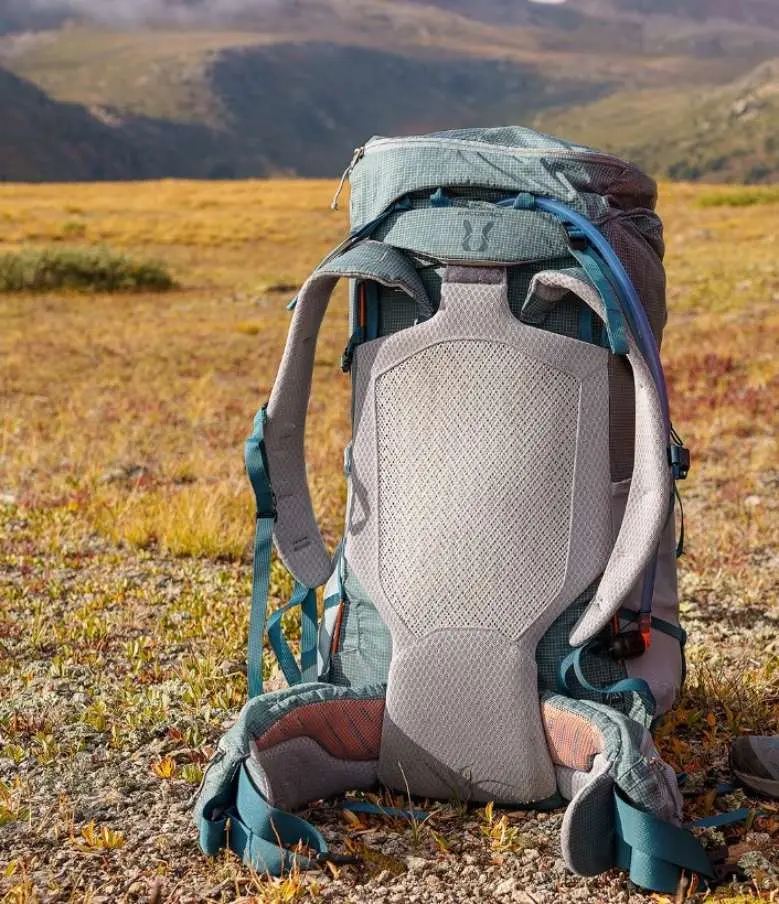
The backpack is measured empty. Its overall height may therefore increase depending on how you load it, particularly if you fill the lid.
The wearer's back length:
Our specialist backpack brands generally specify a recommended back length. This is a guide rather than an exact measurement, but if your back is clearly shorter or longer than the stated length, you may find the backpack uncomfortable.
The information gives a size range, for example 40 to 54 cm, which can be wider or narrower depending on whether the back length is adjustable. Backpacks over 50 L often have an adjustable back length. This varies for 30 to 45 L packs and is quite rare below 30 L, although it matters less because you carry less weight. Some backpacks come in 2 sizes, S/M and L/XL, with 2 back-length ranges specified.
First, you need to understand what ‘back length’ means and how to measure it. All brands give the same guidance: measure between the 7th vertebra and the top of the hip bone.
Clear? No? Then here is how to do it correctly.
You need to measure the distance between your neck and the top of your hip:
- Find the top of your hip bone: place your hand on your hip and feel the bone beneath your thumb.
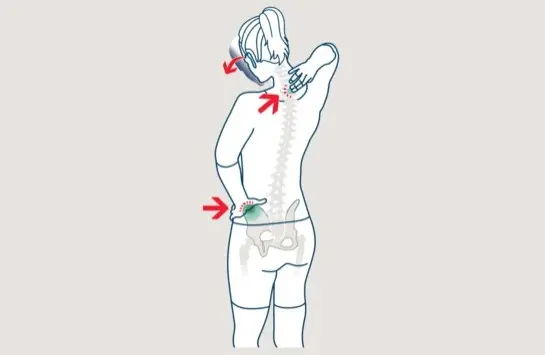
- Once you have located it with your thumb, the easiest approach is to position a belt between the 2 highest points of your hips, marking this height at your spine.
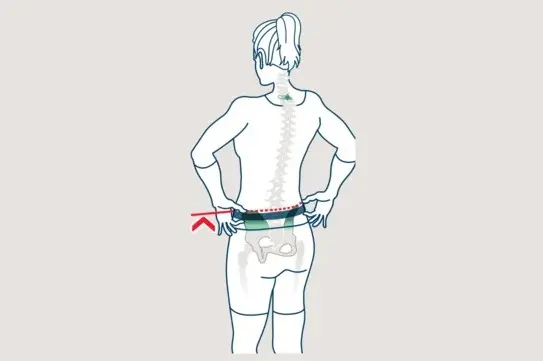
- Find the 7th vertebra: it is at the base of your neck. You can feel it immediately when you place a finger on it: it is the vertebra that tilts when you bend your head.
- Use a flexible tape measure, or a DIY tape measure if necessary, to measure this neck-to-hip distance between the 2 reference points.
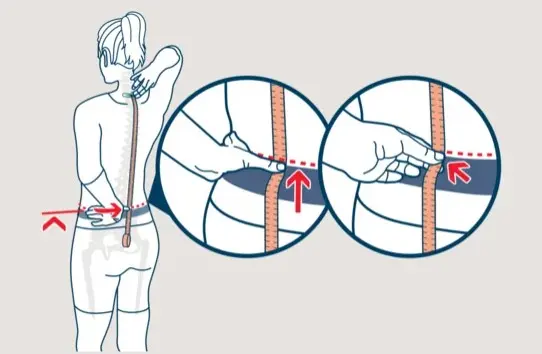
You can then compare this measurement with the ‘Neck-to-hip height’ in the backpack description to check that you fall within its size range.
Again, this is not an exact measurement down to the centimetre, but if there is a significant difference the pack probably will not fit. Call us if you are unsure.
This short video explains how to do it:
Conclusion:
Getting the backpack size right is generally an issue for people with short backs, and less often those with very long backs. This is not solely related to your height: you can be of average height and have a short back. It also matters if you want to carry a very large backpack for your build, such as a 60 L pack for a woman of average height.
The 2 measurements we provide should normally help you confirm that the backpack suits your size.
But beyond size compatibility, consider what you can carry comfortably. Someone weighing 50 kg who wants a 60 L pack may face another constraint: an excessive load that is hard to carry when the pack is full.