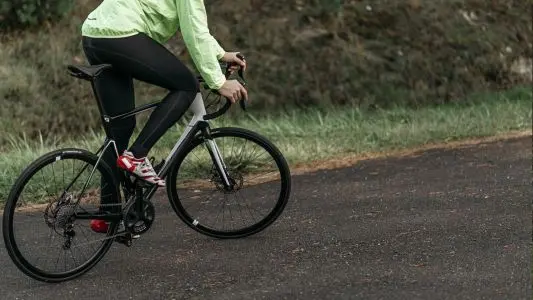
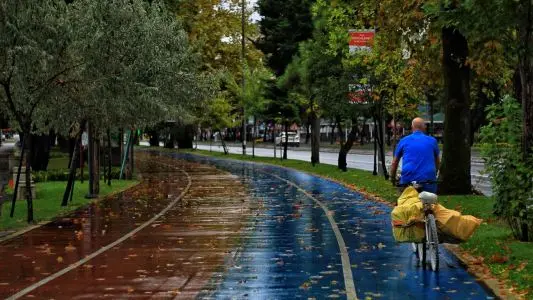
Whether cycle touring in fine weather or commuting by bike all year, you do not let rain stop you.

But rain protection on a bike involves constraints that are difficult to reconcile:

  • Rain exerts greater pressure on a cyclist's clothing than a hiker's. Moisture therefore penetrates faster.
  • But wearing a “watertight” or thick garment means sweat cannot escape. When hiking, that is unpleasant. When commuting, arriving damp and “fragrant” is particularly unwelcome.
  • The feeling of cold is also intensified by moisture and airflow. This calls for insulating layers in colder seasons. You must manage sweat condensation caused by the temperature difference between your body and the surrounding air.
  • Hands and feet are particularly exposed, which can be painful.
  • But you must protect your hands while retaining good dexterity.
  • You must also protect your head without interfering with your helmet or visibility, particularly when turning your head.
  • Finally, you need to protect yourself from rain while remaining clearly visible to others.

From head to toe, RayonRando reviews different ways to protect yourself from rain while cycling.
Alongside our equipment expertise, we drew on the experience of 2 dedicated year-round cycle commuters: Jeff rides 25 km each way daily on a road bike through countryside and town; Fabien rides 5 km each way through town on a touring bike. They have both the endurance and experience.

Different equipment according to distance, effort and season:

Before going into detail, remember that your equipment may vary substantially according to distance, effort and season:

  • Short cycling distances, 4-5 km, and/or e-bike journeys: up to around fifteen minutes, without pushing hard, you perspire little and do not have time to warm up in winter either. You can therefore wear more protective, less breathable clothing, especially in winter.
  • Long distances and physical effort: you have time to warm up in winter and perspire in any season; your legs also need complete freedom of movement. Choose breathable clothing that does not restrict them.
  • Season: in autumn/winter, equipment must protect from both rain and cold, while lightweight clothing is welcome in summer.

Protecting your face and head

How do you protect your face from rain while cycling? Rain does more than soak you: it reduces visibility.
The first option is your rain jacket's hood. But a cycling hood can restrict sideways vision, particularly when turning your head, as it may not follow the movement. You therefore need:

  • A hood large enough to cover your helmet. However, a large hood can catch the wind.
  • The hood must therefore tighten to cover your head without covering your face. Prefer hoods with rear depth adjustment for a precise fit.

Without a hood, or as a supplement, several solutions exist:

  • Helmet: choose one with a peak to protect your face.
  • Cap: its peak protects your eyes. Waterproof caps are very practical on a bike, provided they fit under your helmet's shape.
  • A waterproof helmet cover protects your head, but not your vision.
  • Cycling glasses protect your eyes from rain but can reduce visibility unless sheltered by a peak.
  • A thin hat under the helmet provides temporary rain protection and an extra layer of warmth.

Protecting your upper body: jacket or rain cape?

If you ride a road bike with a closed frame and forward-leaning position, you need a close-fitting jacket. A rain cape is unsuitable.
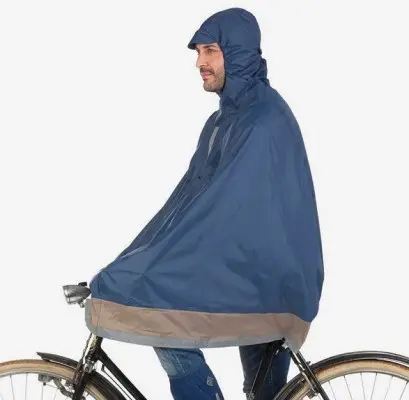
On an urban, touring or, more generally, open- or semi-open-frame bike with flat handlebars, you ride seated upright. You then have a choice of rain cape or rain jacket.

Rain capes for cycling:

Advantages:

  • Optimal ventilation. Capes allow excellent airflow, reducing perspiration build-up.
  • Extensive coverage and effective protection. They cover the cyclist and part of the bike, keeping the upper body and legs relatively dry. They are generally completely waterproof. You will not get soaked.
  • Easy to put on. Quick to put on and remove, practical for sudden showers. They eliminate the need for waterproof trousers if you accept wet lower legs. Your everyday coat fits comfortably underneath.

Disadvantages:

  • Wind exposure. In windy weather, capes can be difficult to control and get in the way. They therefore suit sheltered urban routes better than exposed countryside roads.
  • Sideways vision. As mentioned above, a poorly adjusted hood can get in the way, especially when turning your head. Sometimes it is better to do without it and protect your head another way.
  • The look? I think it suits you, but that is your decision…

Rain jackets for cycling:

Advantages:

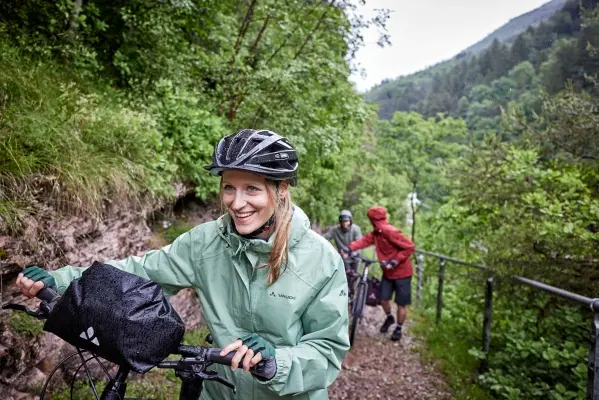
  • Both waterproof and breathable, they offer a good balance of water protection and perspiration removal.
  • Close-fitting, minimising wind exposure.
  • Versatile, they also act as a windproof layer and can be worn on foot all day after leaving the bike. A waterproof, breathable, insulated winter coat also serves all day. In spring or autumn, a lighter jacket can go over a casual jacket.

Disadvantages:

  • The membrane's waterproofing has limits. In prolonged or driving rain, water eventually penetrates.
  • Less airflow. Compared with capes, they offer less ventilation, potentially uncomfortable depending on exertion and weather. Heavy perspiration may eventually condense.

How do you protect your hands from rain while cycling?

Very exposed, hands are the first to suffer when rain combines with cold.

Cycling gloves:

On a bike, you need dexterity for braking, changing gears and manoeuvring. Thick ski-style gloves, the only truly very warm ones, are often too bulky to control the bike, brakes and gears, and generally not waterproof. Lined leather gloves provide good warmth but soak up rain.

It is often better to use thinner, close-fitting, less warm gloves that let you use your fingers properly:

  • Softshell or neoprene gloves are useful for thermal protection and wind resistance. Their insulation has limits, especially in rain.
  • Adding silk liner gloves, or liners reflecting the body's infrared heat, may be useful. However, if this double layer compresses your fingers, circulation decreases and they will feel cold…
  • Waterproof gloves also exist, providing rain, wind and thermal protection. 

Handlebar mitts:

Handlebar-mounted mitts offer extended protection up to wrists and forearms. They protect from rain and are padded, so mainly suit autumn/winter use. Use them alone or with thin gloves.
Their drawback is relative bulk and reduced dexterity, particularly in emergencies, with the hand enclosed inside.

Waterproof trousers

Essential with a rain jacket, waterproof trousers are also useful but optional with a rain cape.
Choose a waterproof, breathable membrane, rather than basic waterproof-only trousers that quickly develop condensation.

Consider ease of putting them on and taking them off:

  • If changing under shelter, elasticated trousers or a short zip may suffice.
  • If dressing urgently outdoors, fully unzipping trousers avoid removing footwear. Quarter-zip trousers can also go over shoes if they are not too bulky. But wet or muddy shoes may dirty the waterproof trousers as you put them on, then soil your clothing.
    Some waterproof trousers have hook-and-loop hem adjusters: very practical to prevent rubbing or catching in the chain.
    Reflective strips can also improve visibility in rain.

How do you protect your feet from rain while cycling?

Alongside hands, feet are the most exposed parts. Quickly soaked, they are hard to warm up when riding in cold or cool weather.
What footwear should you wear for cycling in rain?
You can choose waterproof, breathable footwear. Even more than jackets, its waterproofing has limits. Some footwear has integrated gaiters. However, you may need to wear everyday shoes. In any case, supplement protection with:

  • Waterproof cycling overshoes enclosing the foot and ankle. They protect against splashes, water ingress and wind.
  • Waterproof socks, effective for extending protection from water and cold.

Conclusion

Protecting the body from cycling rain is therefore fairly easy with suitable clothing. It is trickier for the head because of vision, and hands and feet because of dexterity and sensitivity.
To find the right balance:

  • For daily commuting, speed and practicality matter because time is limited. On an e-bike or short, undemanding journey, perspiration is not a constraint: less technical clothing may suffice.
  • For long rides or cycle touring, equipment must provide lasting protection, as you may face prolonged exposure without shelter. Extended exertion also generates heat and perspiration, requiring truly breathable clothing. 

Finally, besides rain protection, consider safety too. Rain makes visibility even more important. Wear reflective details to be seen by other road users. Keep front and rear lights working and use flashing lights to attract more attention.

Product comparison
Compare
Rayon Rando advice