Which pocket knife for outdoor activities or hiking?

Whether hiking, wild camping or travelling, a pocket knife is a simple but essential tool. There is no need for an oversized or overly complex model: outdoors, a good pocket knife is above all reliable, practical and suited to actual use.

Here is how to choose the most suitable pocket knife for your outdoor trips, with clear technical guidance and pointers among the market's leading models.

What is a pocket knife used for outdoors?

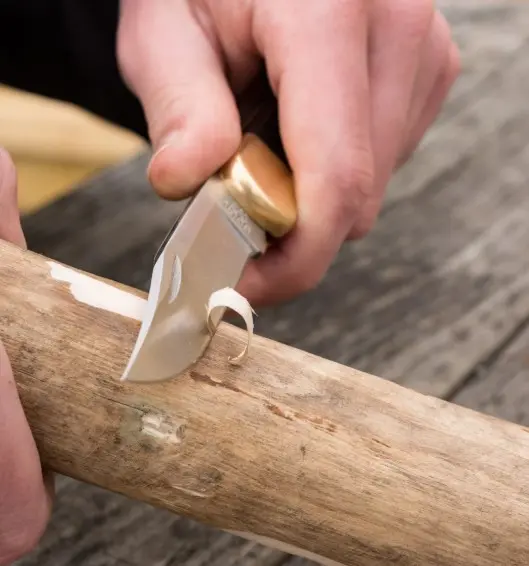
Outdoors, a pocket knife primarily handles small everyday tasks: preparing food, opening packaging, adjusting equipment or whittling a small piece of wood. It is also essential in a repair and emergency kit.

For most hikers, a folding pocket knife is more than sufficient. Lighter, more discreet and easier to carry than a fixed-blade knife, it covers most field needs. Choose a model suited to occasional or regular use without going overboard.

Essential criteria for choosing an outdoor pocket knife

The blade

The blade is the essential element.

What blade length should a pocket knife have? 

For outdoor use, moderate length is preferable: 

  • An 8 cm blade usually works well: the knife stays compact with a good grip, and the length suits both food preparation and repairs.
  • A smaller 7 cm or even 6 cm blade (no less) suits 2 cases: small hands needing a proper grip, or a “just in case” knife that is as compact and light as possible.
  • A larger blade suits large hands or more forceful work (carving a medium-sized branch, for example). However, 9 or 10 cm seems the maximum to avoid excessive bulk.

    Which steel for a pocket knife?

    Steel choice is also decisive:

    • Stainless steel: more tolerant of moisture, easy to maintain with no special care, ideal for hiking and travel. Do not overthink it: it suits 95% of cases.
    • Carbon steel: excellent sharpness, but needs more care because it oxidises. Dry immediately after use or washing. Reserve it for very regular users who always want a very sharp edge.

    Grip and safety

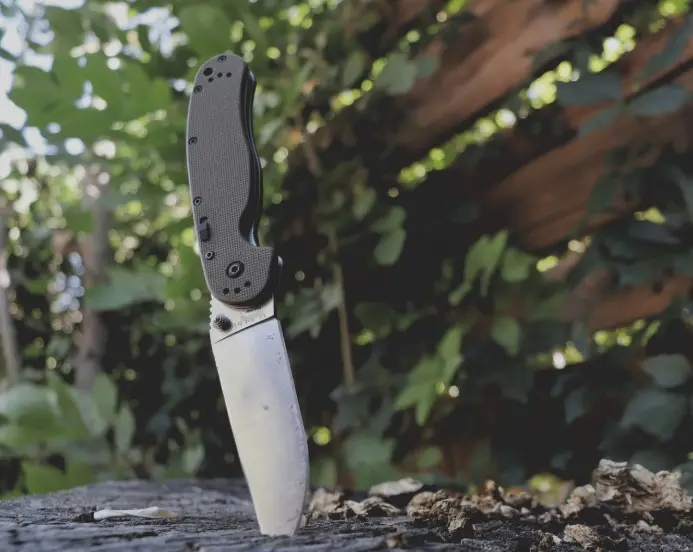
    A pocket knife should offer secure grip, even with cold or slightly damp hands. Handle shape, ergonomics and blade lock, where present, directly contribute to safe use:

    • At RayonRando, we find a slightly convex handle around 2 cm thick gives good grip. The Opinel no. 8 also grips well for an average hand. Swiss Army knives generally offer poorer grip.
    • For safety, we think avoiding blades without a proper lock (“slipjoint”) is sensible, favouring secure locking systems. Locks on top of the handle (backlock) are the most comfortable and effective: locking is automatic and release easy, but cannot happen accidentally. Opinel's locking collar is also very secure, provided you remember to close it (forgetting happens…).

    Weight and bulk

    Every gram counts when hiking. A light, compact pocket knife slips easily into a pocket or backpack without becoming a burden. This is sometimes overlooked but useful on multi-day trips. Knives around 50 g are available, and staying below 100 g is generally possible.

    Simple knife or multifunction knife?

    Two main families stand out for outdoor use.

    A simple pocket knife focuses on effectiveness: a blade, handle, locking system and nothing unnecessary. Often the best choice for those seeking lightness, simplicity and excellent cutting quality.

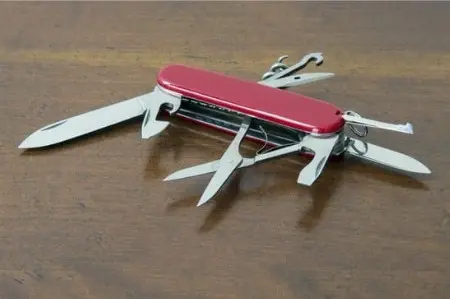
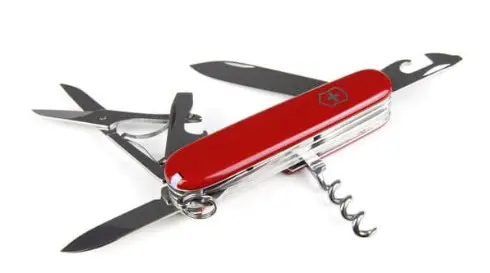
    A multifunction knife offers greater versatility. Useful when you want several tools in a small package, particularly on multi-day hikes or travels. However, as a knife, its grip is poorer than a simple pocket knife's.

    Opinel and Victorinox: two essential references

    Opinel knives

    Opinel is a benchmark all-purpose pocket knife. Simple, reliable, light and economical, it is often a hiker's first outdoor knife.

    Made in France, it is a very sensible choice for hiking, occasional camping or travel:

    • Good grip, good sharpness and easy sharpening
    • Simple maintenance in the stainless steel version
    • The locking collar is completely reliable. But remember to close it, as this is not automatic.

    Over time, opening can become stiff: tapping the handle end against a surface releases the blade from its slot.

    Which Opinel knife should you choose?

    If unsure, the choice is simple: take the Opinel no. 8 VRI (an 8 cm stainless steel blade). The handle gives average or small hands a good grip, and blade length suits most uses.

    Opinel no. 6 and 7 suit small hands or those seeking lightness and compactness. Smaller models are really too small to be useful, except for specific needs.

    Opinel no. 9 models are noticeably bulkier than no. 8. They suit large hands or a need for a longer edge (carving a medium-sized branch, for example).

    From no. 10, Opinels become bulky, and you should consider whether the intended forceful use would justify a fixed-blade knife instead.

    Victorinox Swiss Army knives

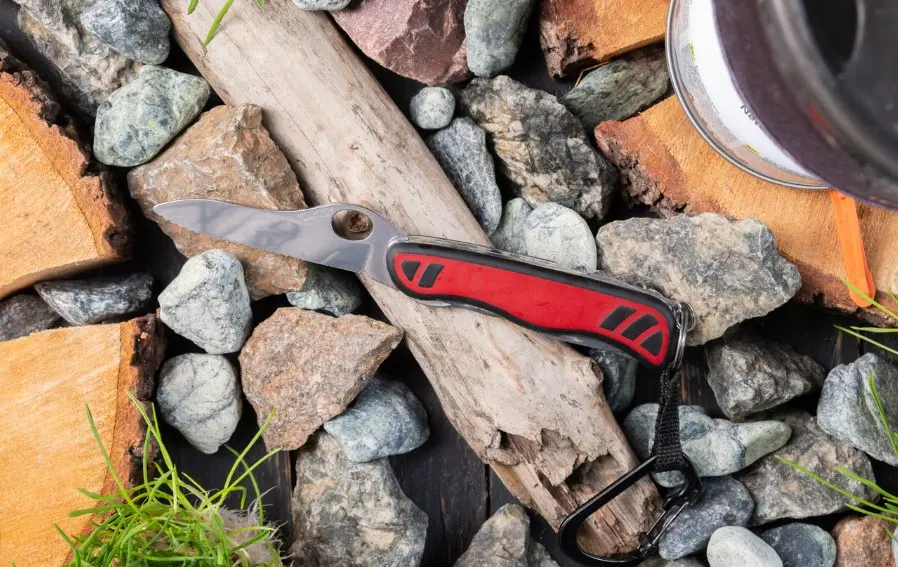
    Victorinox is the ultimate reference for multifunction Swiss Army knives. It is probably the only brand making small multifunction knives this reliable (no play and outstanding toughness). Copies often show assembly weaknesses. Its versatility is particularly valued when several tools are needed in a compact format.

    For outdoor activities, a Victorinox knife is ideal for hiking, travel and outings where versatility matters more than specialisation. Combining many tools helps lighten first-aid, repair and medical kits.

    Which Victorinox Swiss Army knife should you choose?

    Victorinox offers a broad choice of models and colours. Handle length is constant (9.1 cm), while thickness varies with the number of tools. For outdoor use and multi-day trips, we recommend 2 models:

    • The Victorinox Spartan weighs only 59 g and stays slim while offering 8 tools and 13 functions. Enough for travelling and slipping into a pocket.
    • The Victorinox Camper (9 tools, 14 functions) is the first model with a saw. Short, but it cuts well! It remains light (74 g) and compact enough for trips or a pocket.
    • Many other variants exist, but remember that more functions and greater thickness make handling more cumbersome.

    French pocket knives: tradition and craftsmanship

    France has a rich pocket-knife culture, with models recognised for quality and identity.

    Le Thiers

    Le Thiers knives are made to strict specifications ensuring high quality. They appeal to hikers and travellers seeking an elegant, well-finished, reliable pocket knife for outdoor outings, retaining authentic craftsmanship and attractive looks.

    The knife's slightly convex shape and thickness provide a firm, comfortable grip. 

    Some particularly popular models: LE THIERS BJB olive wood 12 cm stainless steel knife BJB.1007, LE THIERS DOZORME olive wood 10.5 cm knife 4920.O, LE THIERS LE FIDELE walnut 12 cm stainless steel knife 3836.

    Folding Laguiole

    Laguiole is an icon of French knives. Recognisable by its design, it offers toughness and a quality blade. Fixed-blade Laguiole knives are best known, but folding versions are available for easy carrying. 

    Outdoors, it particularly suits occasional hiking or travel use. It also appeals to those who prefer a knife with character for both outdoor and table use. Bringing out a Laguiole at a picnic adds eye-catching elegance.

    Some quality yet fairly affordable models: BUCK Trunk black knife 0252Bks, DOUK-DOUK Chrome 9 cm stainless steel knife 61715, LAGUIOLE LE FIDELE full-handle violet wood 12 cm stainless steel knife.

    Which pocket knife suits your outdoor activities?

    The right knife depends primarily on your activities:

    • Day hiking: a simple, light, reliable pocket knife is more than enough.
    • Multi-day hiking and camping: a robust or multifunction knife adds comfort, but a simple knife optimises weight and bulk.
    • Travel, vanlife, cycle touring: versatility and compactness often take priority, but you can also allow an elegant knife you enjoy using.

    In every case, a knife suited to actual use is better than an overly complex or oversized model.

    Conclusion: how to choose your outdoor pocket knife

    Choosing an outdoor pocket knife is primarily about finding the right balance of simplicity, reliability and actual use. From proven names such as Opinel and Victorinox to French Le Thiers and Laguiole pocket knives, a wide range now suits hikers' and travellers' needs.

    The main criteria remain blade size and quality, and grip comfort. However, their importance may shift when seeking lightness, compactness or easy maintenance.

    Rayonrando's pocket knife range covers these different needs, from simple, economical knives to more versatile or traditional models.

    Product comparison
    Compare
    Rayon Rando advice