Choosing a backpack can be a sizeable problem… Especially if you are not tall.

For shorter people, finding a 10 to 20 L backpack is fairly easy. Up to 30 L, not every backpack fits, but it remains reasonably straightforward. Above 35 to 40 L, things become trickier.

In this article, we explain how to find a medium- to high-capacity trekking backpack suited to a shorter person.

What counts as short?

It is relative, but when choosing a trekking backpack, height becomes a real consideration if you are around 1m60 or shorter. It can also be a constraint if you are taller but have a short back.

In this situation, choosing a backpack involves 3 constraints:

  • The bulk of the pack you can carry without restricting movement.
  • The pack weight you can carry comfortably.
  • How well the pack fits your body shape and short back.

Choosing according to the loaded pack's volume and weight:

You are setting off on a multi-day trek, or perhaps a weekend with wild camping gear. In both of the 2 cases, you will have quite a lot to pack. Your backpack must be large enough without exceeding a volume and weight that would get in the way or become uncomfortable.

Why capacity matters: consider a manageable, comfortable weight limit 

From our experience at RayonRando, the loaded pack's weight becomes a real constraint once it exceeds 20% of body weight. This is a guideline; your experience may differ.

Shorter people are most often women with a light build. However, some may have a stocky or broader build: ‘short but strong’.

Let us take the 2 scenarios:

You are a woman measuring 1m60 and weighing 53 kg.

Carrying more than 10 or 11 kg for several days will be uncomfortable and tiring. You will need to optimise your load. You should therefore choose a backpack that is:

  • Fairly light, while retaining a reasonable level of comfort.
  • No larger than 45 L: aside from its bulk, a fully loaded 45 L pack will already approach your weight limit. If you choose a larger pack intending to fill it, you risk carrying too much weight.

You are a stocky man, measuring 1m62 and weighing 75 kg.

You can carry more weight comfortably. You can therefore choose a backpack that is:

  • Very comfortable, even if it is not the lightest.
  • But with a capacity suited to your height: above 50 L, the bulk may get in your way.

Why pack height matters: consider bulk 

The pack's volume can also restrict movement. More than width, it is mainly excessive pack height that can cause problems.

However, the inconvenience also depends on the terrain along your route:

  • It will be greater in the mountains and on climbs, as you regularly raise your head to look uphill. If the pack rises too high behind your head, it will restrict this movement.
  • It will be less of a problem on flat ground or on the Camino de Santiago, for example, where gentler terrain and slopes require less looking upwards.

At RayonRando, we have measured the height of empty backpacks. This lets you check that the pack will not rise too high. You will also need to adjust your load to avoid overfilling the extension collar or lid pockets.

Choosing a backpack for your body shape: a carrying system for a short back.

How can you be sure a backpack will fit a shorter person?

First, check whether the backpack has an adjustable back:

This means you can reposition the shoulder straps on the back to adjust the distance between hip belt and shoulder straps:

  • If the backpack has a fixed back, the distance between hip belt and shoulder straps is generally designed for a standard size. You can only tighten the shoulder straps; if their attachment point is too high on your back, you will not be comfortable. 

However, a fixed back on a pack labelled ‘women's’ has a shorter distance between hip belt and shoulder straps. The pack is therefore a slightly better fit. A women's backpack can also suit a man with a smaller build.

  • If the backpack has height-adjustable shoulder straps, it will be much easier to fit precisely to your body shape. The lowest setting generally corresponds to a very short back.

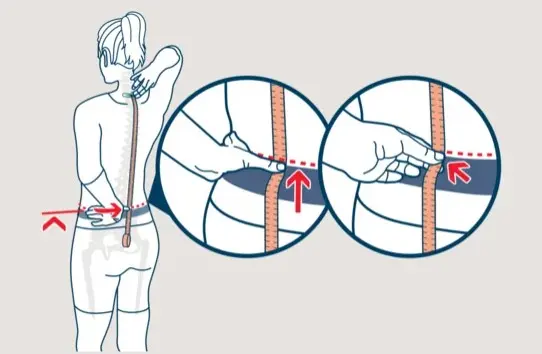
Measure your back to find the distance between your hip bone and 7th vertebra:

Specialist backpack brands such as Gregory, Deuter and Osprey specify the back length a pack suits, with a minimum/maximum range. We systematically include this information in product descriptions on RayonRando.com. More generalist brands, however, do not provide it.

This measurement gives you a reliable indication of whether the pack fits your size.

But how do you measure your back length?

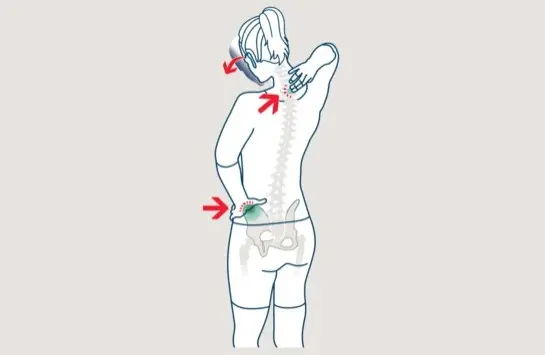
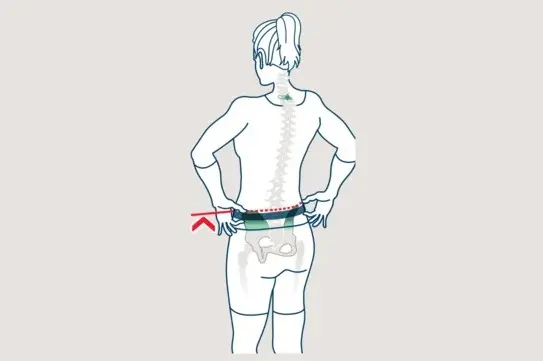
  • The easiest method is to position a belt at the top of your hip bone, which you can easily feel. 
  • Then measure from the belt to the 7th vertebra. To find it, simply bend your head: the 7th vertebra is the one that bends at the base of your neck; the one below does not move.

Compare this with the pack's stated size range to check that it fits. It is not an exact measurement down to the centimetre, but if there is a difference of several centimetres, you can be sure it will not suit you.

Conclusion:

To find a suitable backpack when you are short, the first step is to optimise your load to minimise volume and weight. The smaller the pack capacity you choose, the easier it will then be to find a suitable model. 

Beyond the specific advice in this article, bear in mind that it is generally difficult for a short woman to choose a pack over 45 L, or for someone with a stockier build to choose one over 50 L.

Of course, the best solution is to find a strong travelling companion and persuade them to carry more. If your companion is reluctant, however, choosing a good backpack remains the best approach. You should find what you need at RayonRando.com. Ask us for advice if you need it.

Product comparison
Compare
Rayon Rando advice