





To help you choose your rain poncho, RayonRando offers a comparison of 4 quality rain ponchos designed for different uses:
- The Ferrino Hiker rain poncho, with press studs and a backpack compartment.
- The Ferrino Trekker Ripstop rain poncho, with long sleeves, aluminised ripstop fabric and a backpack compartment.
- The Pro-X Bern rain poncho, with long sleeves, a waterproof yet breathable membrane and extra features for cycling.
- The Sea to Summit Ultra-léger 15 D poncho tarp: ultralight, opens fully and can be used as a tarp.
The first 3 models come in 2 sizes. Under 1.70m, choose the smaller; over 1.75m, the larger. Between 1.70 and 1.75m, either of the 2 may suit. Choose larger if you have a broad build and carry a large backpack. Stay with smaller if you are slim, especially with a small backpack.
Packed comparison:
Here are the 4 capes in increasing order of weight and packed size.
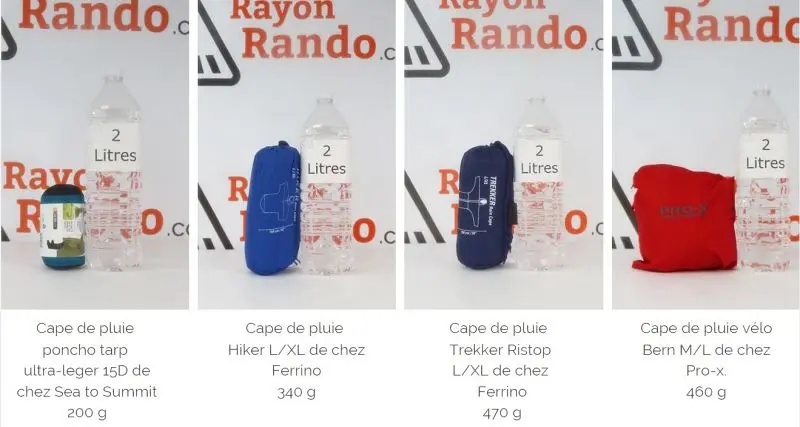
For ultralight hiking, the answer is clear: the Sea to Summit Ultralight 15 D poncho tarp. However, the final section shows a relationship between weight and durability. Before choosing by grams, read on to see what is most practical in use.
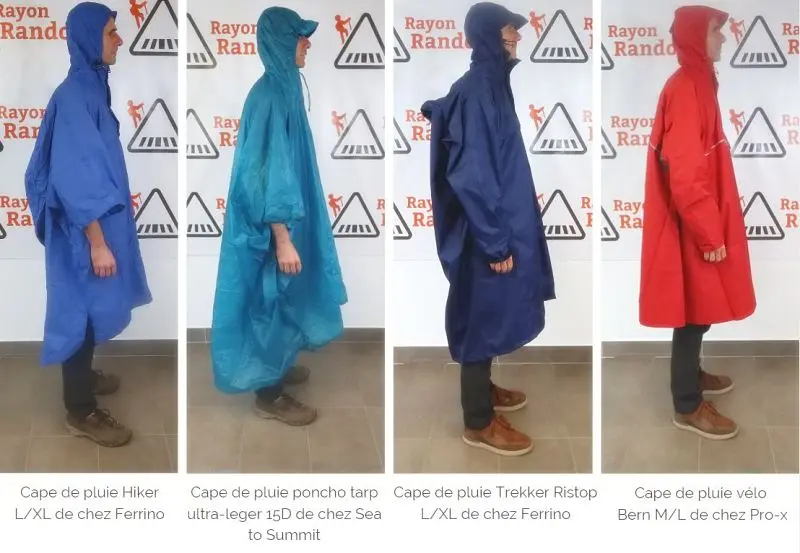
Comparison worn without a backpack:
For sized capes, in the photos I wear Ferrino L/XL and Pro-x M/L models.
Trying them on:
- The Ferrino Hiker and Sea to Summit 15 D ponchos, without proper sleeves, still cover the arms reasonably well and let air circulate. Models with sleeves offer more protection but less ventilation.
- Ferrino's backpack compartments can be stowed using press studs, very practical without a pack or with a small one.
- The Pro-x Bern's fabrics are clearly the most pleasant in feel and flexibility. It is the cape closest to a rain jacket: besides a waterproof, breathable membrane, it has a pre-shaped hood peak and depth adjustment. Very practical for protection while preserving your field of vision. It also suits cycling, with hand loops, straps to reduce wind exposure and stowable overmitts for complete protection.
Trying them without a backpack is the least demanding situation. All 4 capes can work.
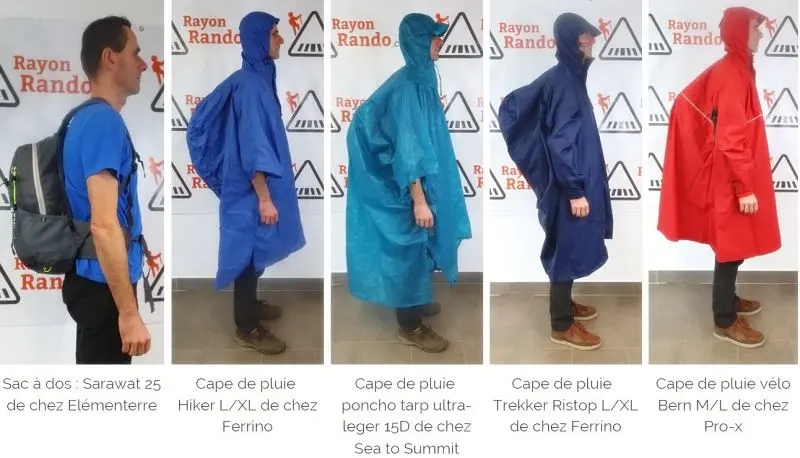
Comparison worn with a small-capacity backpack:
The photos use a loaded 25L backpack.
Again, all 4 can work. The 2 ponchos, Sea to Summit 15 D and Ferrino Hiker, catch more wind but are consequently better ventilated for summer hiking and remain easy to put on.
In my view, the Pro-X Bern remains the most pleasant. The Ferrino Trekker is the toughest and can also serve as a seat at picnic time.
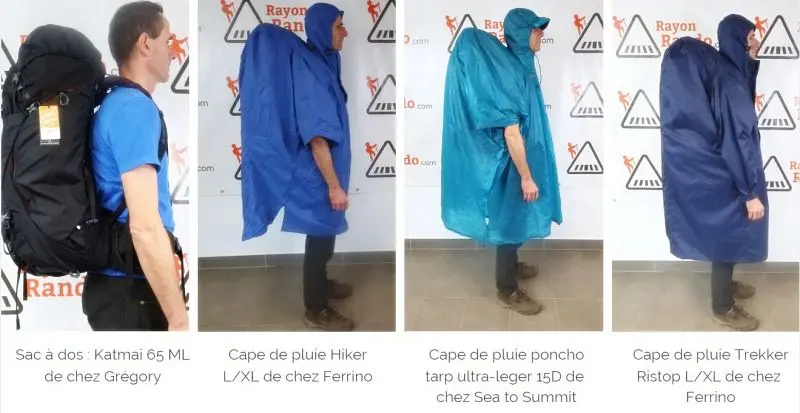
Comparison worn with a high-capacity backpack:
The photos use a large, loaded 65L pack.
I am not showing a photo with the Pro-X Bern: there is clearly not enough room to cover a large pack comfortably. Rule it out.
The Sea to Summit 15D cape also suits large-capacity packs. It reaches low enough at the back and allows comfortable arm and leg movement. But with a large pack, it rises above the elbows, leaving your forearms wet.
The dedicated backpack compartment on the Ferrino Hiker and Trekker is a real asset: the cape reaches low enough behind to protect both pack and wearer fully. However, the Hiker is awkward to put on and restricts leg movement. I think it suits packs up to 50 L that are not loaded too high.
The Ferrino Trekker is clearly the best suited: easy to put on, with good coverage while retaining freedom of movement.
Protection and durability comparison:
For protection, the 2 long-sleeved Trekker and Bern capes have a real advantage, covering the entire arms. The aluminised Ferrino Trekker is also more insulating and the toughest. But the Pro-X Bern is more breathable, with its membrane rated waterproof to 10,000 mm and breathable to 5,000 g.m².24h.
The Sea to Summit 15D cape will normally be less tough because of its thinner fabrics. Worn directly over a T-shirt, it also provides less insulation against the cold of rain.
To put a cape on over a backpack, the Trekker's full zip is more practical. The others take practice: put your head through first, then throw the cape backwards so it falls correctly. With a high-loaded pack, a friend's help is welcome.
The sleeveless Hiker poncho with press studs opens out for use as a groundsheet or tarp for grassy lunch stops or wrapping belongings. The Sea to Summit 15D also has attachment straps to pitch it as a tarp. However, I advise against sitting on it because the fabric is so thin.
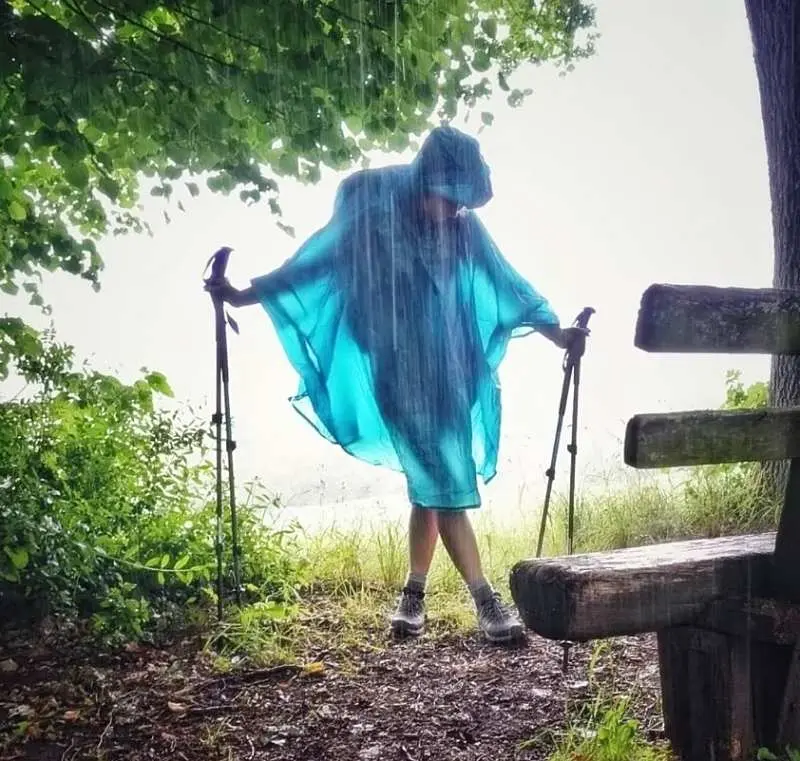
Conclusion:
All 4 capes have advantages and limitations.
In my view, the Sea to Summit 15D suits those truly counting every gram or with very little space to pack it. For long trips, something slightly heavier but tougher and more practical may make sense.
The Ferrino Hiker poncho is versatile, fairly light and practical with a medium-capacity pack not loaded too high: a useful all-purpose cape. I like using it as a groundsheet for lunch on grass.
The Pro-X Bern seems the most pleasant worn alone or with a daypack, up to around 40 L in my view. It is not only waterproof but also breathable, making it useful for sustained efforts combining rain and perspiration. Also ideal for cycling.
The Ferrino Trekker is very practical, very tough and insulating. A good investment for long treks or wet-season use, whenever you may really need it…