How does Bernoulli's principle inflate your sleeping mat?

Remember a few years ago, when you finished a day's hiking tired, one small task remained to finish you off: blowing up your inflatable sleeping mat. Depending on the volume of the mat and your lungs, it sometimes took 30 to 40 breaths. Still, it could not do you any harm…

Today I inflate my Némo Tensor mat with 2 breaths… Have mats shrunk? No. Are my lungs bigger? Perhaps, but that would not explain why it works for you too.

A look back at one of the outdoor sector's major technical innovations of the past 10 years: inflating sleeping mats quickly without straining our lungs.
This feat seems so simple thanks to the pump sacks supplied with mats. Yet nobody thought of it earlier… It rests on an 18th-century discovery, Bernoulli's principle. Someone still had to invent the practical application…

What exactly is Bernoulli's principle?

Daniel Bernouilli formulated Bernoulli's principle in 1738.

Want the unclear version? “In fluid flow, acceleration occurs simultaneously with a decrease in pressure.”

You look doubtful. Let me rephrase: the faster a fluid, such as air or water, flows, the lower its pressure.

So what? Lower pressure creates a force. In aviation, this contributes to lift on aircraft wings. That is not today's subject, but the wing's movement makes air flow faster above it than below. The faster air above therefore has lower pressure than the air below. This pressure difference “sucks” the wing upwards and helps the aircraft fly.

How do we get from aviation to a sleeping mat?

When I put my mouth directly on a mat's valve, I blow in only the volume of air in my lungs. So far, so clear.

According to Bernoulli's principle, blowing air from my mouth creates a fast airflow with lower pressure than the surrounding air. This draws in ambient air. I therefore move more air than I exhale. See the idea? If that larger volume entered a mat, I could inflate it much faster.

If it is still unclear, here is my short video demonstration using a bin bag:

You can repeat the experiment at home: it is astonishing!

A Therm a Rest invention, copied and especially improved by other brands:

Turning the principle into practice required an idea from leading hiking mat brand Therm a Rest.

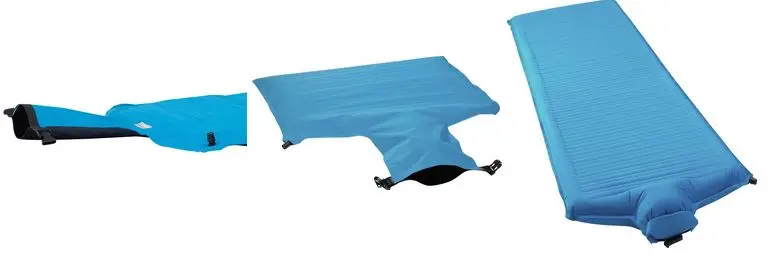
The 1st mats using the innovation had an inflation sleeve rather than a valve (in 2016, with the Therm A Rest NeoAir Camper SV). It worked well but had 2 disadvantages: the mat was heavier and not everyone understood the technique, making it awkward for some…

Photos of the therm a rest Camper SV mat:

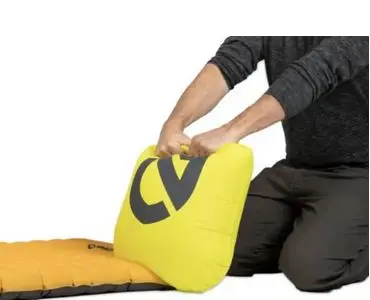
Competitors soon took an interest. Némo and Sea to summit in particular found a much more practical application: keep a one-way valve on the mat and connect a pump sack to it. Inflate the sack, then compress it with your hands to push air into the mat. Practical, clever, brilliant!

A short demonstration on a Némo mat, the most refined in this respect in my opinion:

The benefits of “Bernoulli” inflation:

First, it inflates your mat incomparably faster. Depending on the volumes of the mat and pump sack, only 2 to 6 breaths are needed, compared with 30–40 when blowing directly into the valve.

The other benefit is effortless blowing: no pressure is needed; instead, blow gently. So setting up camp takes no effort.

It is very quick and restful.

Why did nobody think of this earlier?

Once you see the application, it seems obvious. It uses a long-established principle that already had practical applications.

So why was it not invented earlier? That is asking too much: I have no idea.

Hiking mats began with foam, then self-inflating models, before lightweight inflatables appeared. Perhaps their widespread use prompted complaints from hikers with less lung power than you?

In any case, it is a real innovation with a real benefit for users. Many thanks to the unknown, daring inventor: a truly inspired idea.

Product comparison
Compare
Rayon Rando advice