

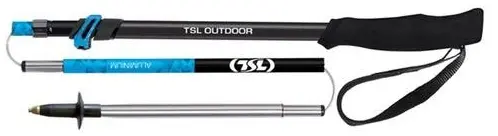
Walking poles do more than provide safety and stability: used correctly, they reduce muscular strain, spread the effort across all 4 limbs and relieve joints. They are particularly useful when hiking with a backpack or over rough terrain.

This short guide will help you choose trekking poles according to your needs and priorities.


Trekking poles: 6 selection criteria:
 

1) Packed size

Your walking pole's packed size is essential if:

  • You are going on a multi-day hike with a small backpack.
    A pair of poles measuring 60 cm when folded may be awkward on a 30 L backpack, for example. So compare the height of your backpack with that of the poles.
  • You only use them at certain times, such as uphill or downhill.
    You will regularly stow them inside or outside your backpack, so they need to be relatively compact.

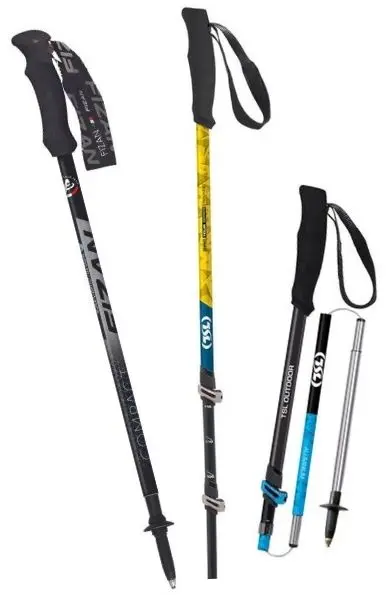
If packed size matters in your situation, choose a 3-section telescopic pole, or even a 4-section trekking pole or a folding pole. However, 2-section telescopic poles will generally still be too bulky.

On the other hand, packed size is secondary if:

  • You are setting off for several days with a large backpack.
    A 60 or 65 L hiking pack has much more room for bulkier poles.
  • You use them throughout your day's walking.
    In that case, whatever your backpack, your poles will be an extension of your hands! 
  • You take them for walks and only need to store them in your car boot or at home.


2) Weight

If you hike self-sufficiently for several days, sometimes with poles attached to your pack, you may appreciate lightweight trekking poles. The same applies if you like hiking light: the feeling of walking with proper poles as light as wands is very pleasant.

But there is a trade-off: the lightest poles generally use thinner materials, such as 7001 aluminium, making them more delicate and less durable. If weight is not a priority, slightly heavier but tougher poles may be worth choosing.

Overall weight depends on features such as shock absorption and grips, and on materials. Carbon is light but more brittle; aluminium varies in strength and weight according to its composition and thickness. But do not expect miracles: if your pole gets stuck in a hole and you lean on it with your full weight like a lever, it will break, however tough it is…


3) Adjustment system
 

There are 3 types of locking system:

Compact trekking poles
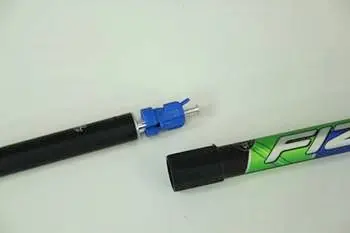
Twist-lock poles are the most common models. Twisting expands a clamp inside the pole to lock the sections. This system is found on the lightest telescopic poles. On Fizan poles, the locking system is effective and requires little force. Budget models need more force to prevent gradual loosening during use, and consequently more force to unscrew. A grip collar on the shaft is a useful little extra.

The locking system on our budget Elementerre poles is of perfectly decent quality, but will still not last as long as on more expensive poles.

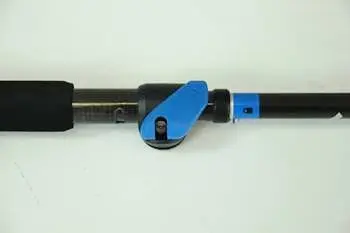
Lever-lock poles: these are simpler to operate. Just open or close the lever to lock the pole. If you struggle to exert force with your hands, this is for you. It is also particularly practical in winter with gloves. However, it is heavier than twist-lock systems. Budget models may also gradually loosen, but a small adjuster lets you set the clamping force.

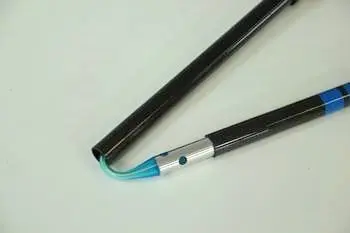
Folding poles unfold easily, pack compactly and are generally lighter than telescopic poles. However, their length cannot be adjusted: fine on flat ground but much less useful in the mountains. Some models also have a short telescopic section allowing 20 cm of length adjustment, but adding weight.

These folding poles can pack down to around 40 cm, very practical for fitting into a small hiking backpack or cabin luggage on a flight.

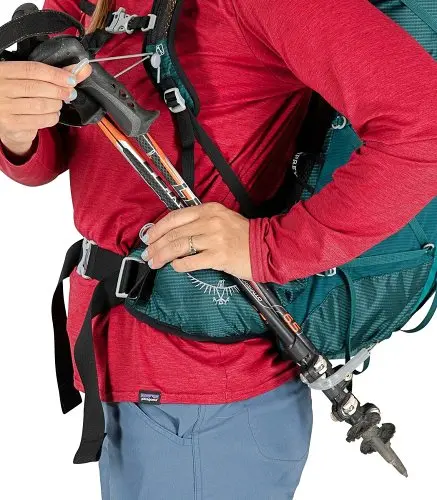
If you have a quick-access pole holder on your backpack's shoulder strap.
Some backpacks, such as the Osprey Stratos 44 or Highlander Ben Nevis 85, have this clever shoulder-strap system so you do not need to remove your pack whenever you want to take out or put away your poles. At Rayonrando, we recommend telescopic poles in this case, with lever or twist locks. They are easier to handle throughout the day.

Discover our trekking poles:

View our twist-lock poles
View our lever-lock poles
View our folding poles

4) Comfort: grip, wrist strap and shock absorption


The grip: comfort varies with the material. Plastic grips on entry-level models are the least comfortable, hard and poorly breathable, and best reserved for occasional use. Rubber is more pleasant, but foam and cork grips are the most comfortable, with cork slightly heavier.

Some grips extend into a sleeve: useful for quickly adjusting your hold when occasionally crossing large obstacles. This avoids injury from holding your hands too high.

In winter, these long grips help on snowy traverses, without needing to shorten one pole.

Some grips are angled; in my opinion, the benefit is rather more marketing than substance…

The pole's wrist strap is not there simply to keep the pole attached to you: it provides continuous support through the movement without gripping the handle tightly. Basic straps are plastic; the best are padded, with neoprene for example. You generally adjust the length once and leave it.
Do not keep your hands in the straps all the time, particularly on technical sections. In a fall, your poles may cause more problems than they solve.
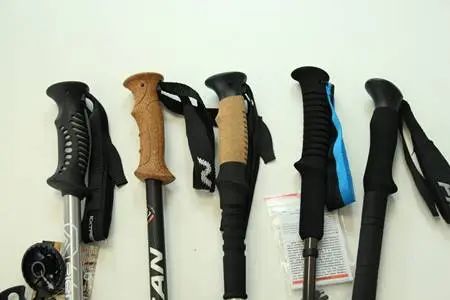
Pole grips

Shock absorbers: a spring system in the upper section cushions shock and vibration with every step. Generally, tightening fully locks the absorber for climbing; loosening one notch releases it for descending. I have tested it: it works. But decide whether you really need it, as it adds weight to the pole.
5) Tips, baskets and caps:

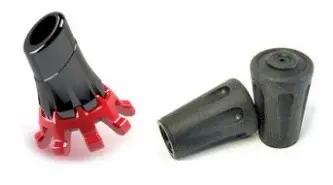
Protective tip caps:

Our poles come with rubber protective caps. When the poles are not in use, these prevent the tips from puncturing or dirtying bags and clothing, or injuring someone. Some caps can also be used while walking, for occasional tarmac sections, for example. This is best kept occasional, as the cap wears down…

On some trails, such as the GR34, you are asked to fit these caps to limit ground damage caused by high visitor numbers throughout the year.

If you are particularly sensitive to pole vibrations against the ground or noise on tarmac, French brand TSL has developed the Kit Crossover caps.

If needed, find all our replacement caps in our accessory range.

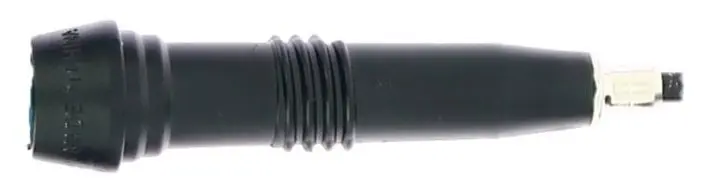
Tips:

The poles in our selection use highly abrasion-resistant tungsten carbide tips. Elsewhere, you may find budget poles with steel tips that blunt quite quickly: reserve these for occasional use. On Fizan and Elementerre trekking poles, the tips are replaceable: Fizan replacement tips or Elementerre pole tips.

Baskets:

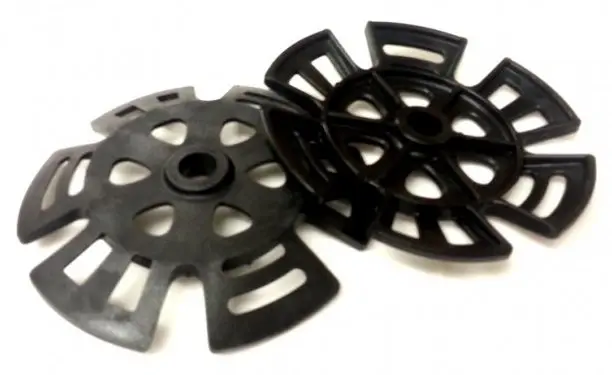
Poles always come with summer baskets and sometimes much wider winter baskets. Otherwise, winter baskets are sold separately among our pole accessories.

Baskets prevent poles sinking into soft ground: useful in summer and essential in winter snow.

Summer baskets also stop you planting a pole in the wrong place, between 2 large stones for example. This is the main cause of trekking pole breakage. Once stuck, a moment's inattention is enough to keep moving and bend or break your pole.

6) How much should you spend on trekking poles?

Our prices vary widely according to pole features and brands.

There is no mystery: budget poles will not last as long, particularly their locking systems. Nevertheless, they are enough for occasional use, flat terrain or a first experience if you are unsure whether you will hike again. In this case, look at our Elementerre poles.

For lasting use, investing more may be worthwhile. Our Fizan trekking poles in particular offer a good balance of lightness, strength and comfort. TSL poles focus on durability and reliability.


Discover our full range of poles for hiking, Nordic walking or trail running, as well as walking sticks:

If you want to save time researching, the Rayonrando team has compiled a list of the 10 best trekking poles.

Product comparison
Compare
Rayon Rando advice