





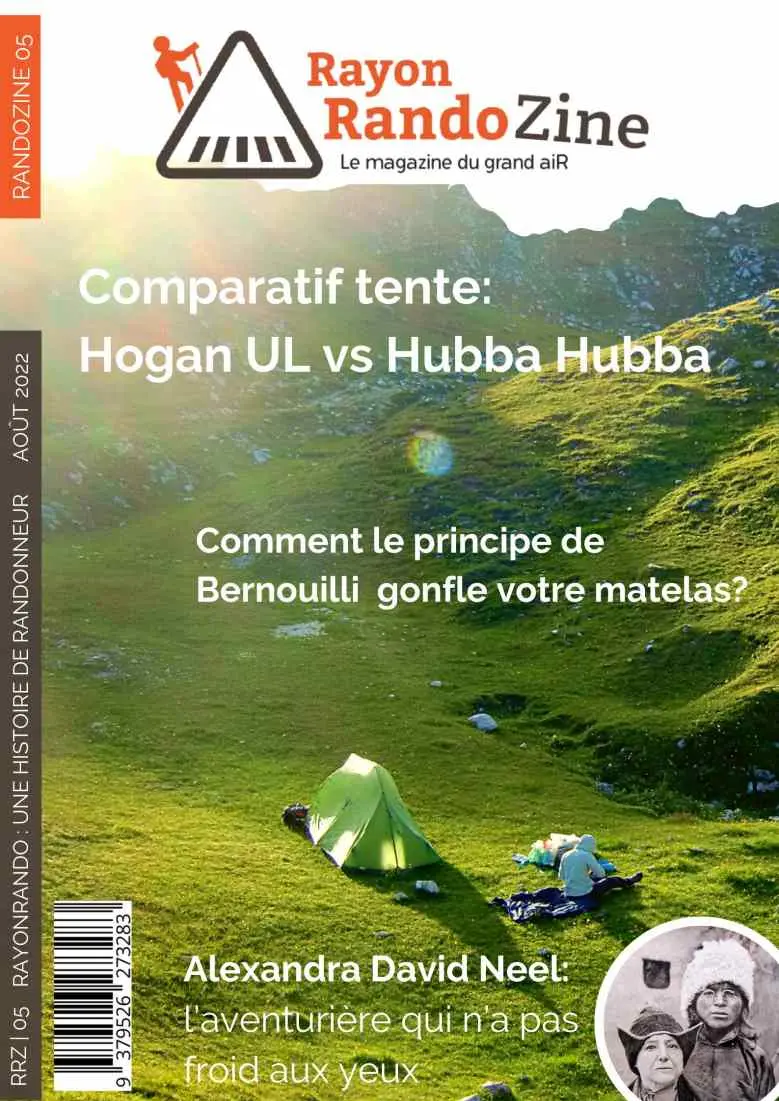
Contents no. 5 - August 2022:
How does Bernoulli's principle inflate your sleeping mat?
Comparison: Hogan UL vs Hubba Hubba
Book: Alexandra David-Néel, the fearless adventurer
Coming soon: Iceland
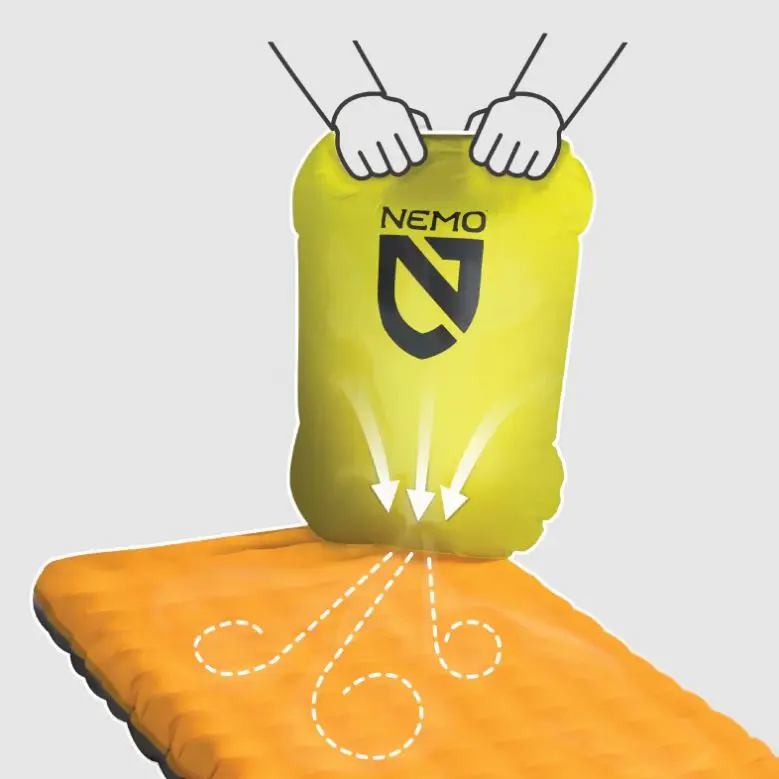 How does Bernoulli's principle inflate your sleeping mat?
Remember a few years ago, when you finished a day's hiking feeling tired, there was one small task left to finish you off: blowing up your inflatable sleeping mat. Depending on the volume of the mat and your lungs, it sometimes took 30 to 40 breaths. Still, it could not do you any harm…
Today I inflate my Némo Tensor mat with 2 breaths… Have mats shrunk? No. Are my lungs bigger? Perhaps, but that would not explain why it works for you too.
What brought about this transformation? Bernoulli's principle! No, it is not this year's discovery: it dates from the 17th century. The real discovery is its clever, even revolutionary application to inflating a hiking mat.
Today I reveal the secret behind this small miracle.
Back to contents
 Comparison:
Hogan UL vs Hubba Hubba
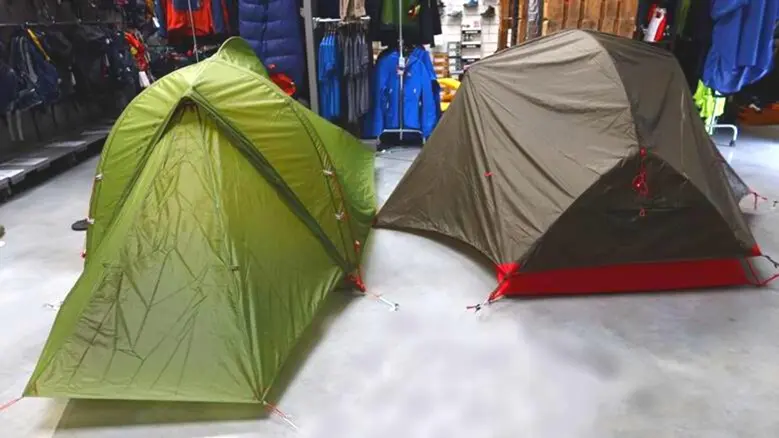
Comparing the Vaude Hogan UL and MSR Hubba Hubba tents:
Here is a comparison of 2 benchmark tents on the wild camping market: the Vaude Hogan UltraLight hiking tent and the MSR Hubba Hubba NX.
What they have in common: a weight below 2 kg, a similar price range and decent comfort. This comparison should help you choose the right one.
Interior space and comfort: advantage Hubba Hubba
The inner tent floor areas are similar: both easily accommodate 2 regular sleeping mats and 2 people lying down. Both provide the necessary width and length.
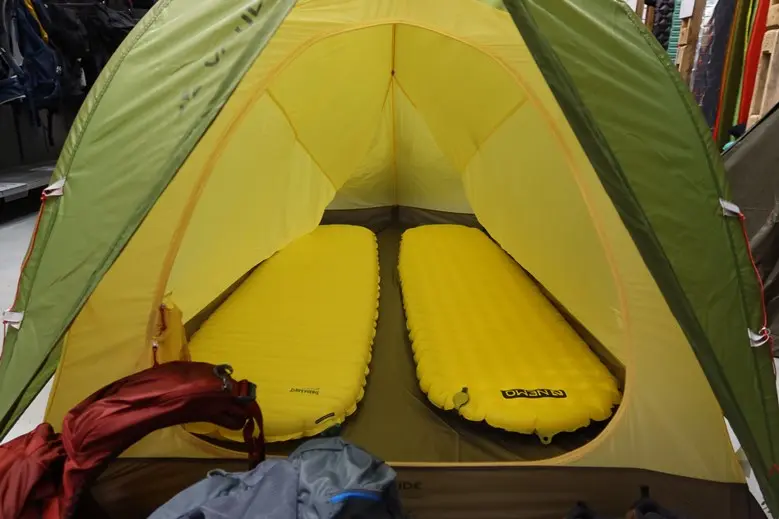
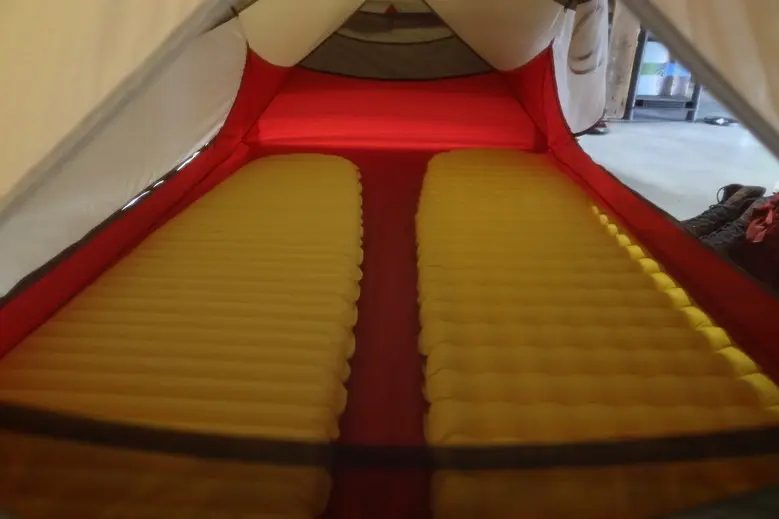
Vaude - Hogan UL MSR - Hubba Hubba NX
Doors and porches are open to debate. The Hubba Hubba has 2 side entrances and 2 porches, so each person can come and go and store their backpack and shoes in their own porch without disturbing the other. However, each porch is small. The Hogan has one door at the head end, with a zip on each side. Getting out is slightly less convenient, although each person can still open their own side. However, an aluminium pole section raises the porch roof, making it spacious at ground level (for 2 pairs of shoes and 2 backpacks) and also in height. Opening the inner tent door creates a more generous space. This makes it easier to cook and eat under cover, for example.
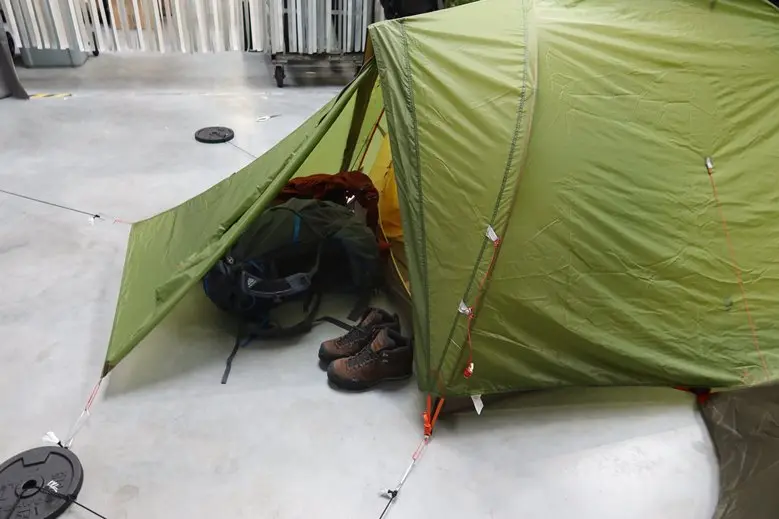
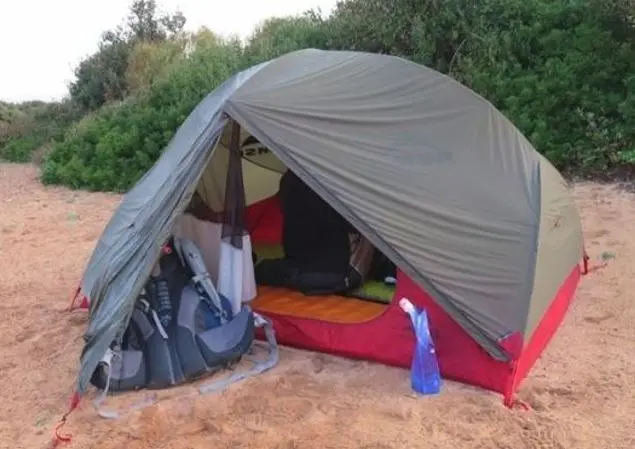
Vaude - Hogan UL MSR - Hubba Hubba NX
However, the interior of the Hubba Hubba is noticeably roomier, with good height from head to foot and vertical walls. You can sit up to change, chat or play cards… You can do this in the Hogan UL too, but its height varies: high over the first half, it decreases towards the feet. Only about half the tent can therefore be used sitting up, making it less comfortable.
Durability and difficult conditions: advantage Hogan Ultralight
For fabrics, there is no contest; the specifications speak for themselves: a groundsheet hydrostatic head of 10,000 mm for the Hogan versus 3,000 mm for the Hubba Hubba, while the flysheet ratings are 3,000 mm for the Hogan versus 1,200 mm for the Hubba Hubba. The fabrics are tougher on the Hogan.
The Hogan UL also offers a stronger construction. Both tents use poles connected to a cross-shaped hub at the apex, giving the structure flexibility and cohesion. But the Hogan Ultralight tent is well streamlined to withstand wind, whereas the MSR catches more wind.
Vaude has also provided a better anchoring system: 15 pegs supplied as standard versus only 10 for the MSR, with cross-section pegs that are stronger and easier to handle than the MSR's pin-style pegs. The Hogan has 6 pre-fitted guylines versus 4 on the MSR. The Hogan also has several strong fastening clips that hold all the tent's elements together.
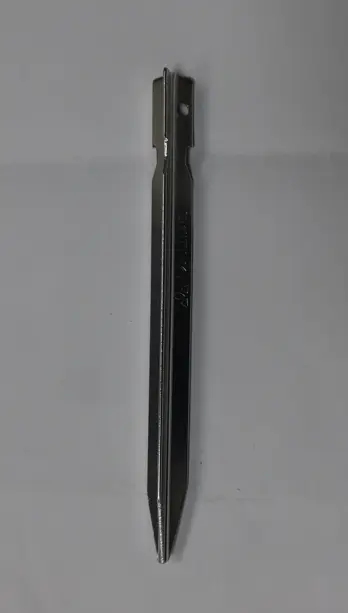
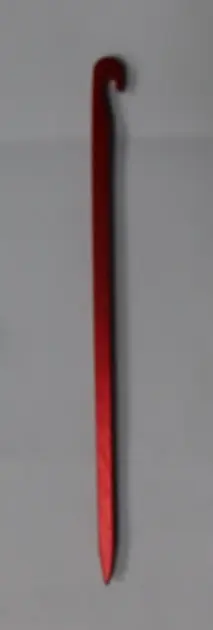
Overall, the Hogan UL is more resistant to rain and wind. It was clearly designed that way. Its outer and inner fabrics also provide better protection in cold weather, although it is not a 4-season tent. I have used it in Iceland in strong gusts.
For the inner tent, the Hogan uses solid fabric that offers better protection from wind, whereas the Hubba Hubba combines solid fabric and mesh, allowing more airflow. This may be welcome or unwelcome depending on conditions (heat, cold, humidity). Mesh also allows any condensation to drip into the inner tent, whereas solid fabric absorbs and disperses condensation droplets.
Practicality: each has its strengths
Packed away, the Hogan UL is longer than the Hubba Hubba. If this is a constraint, you can get around it by storing the poles separately in your backpack, allowing the fabrics to be folded more compactly. It is also slightly heavier (on our scales: 1,980 g versus 1,740 g). The Hubba Hubba is easier to pack into bicycle panniers or motorcycle cases.
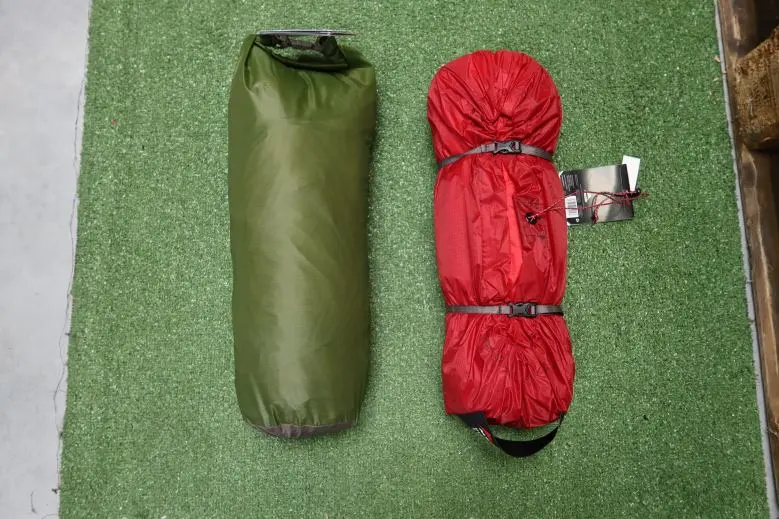
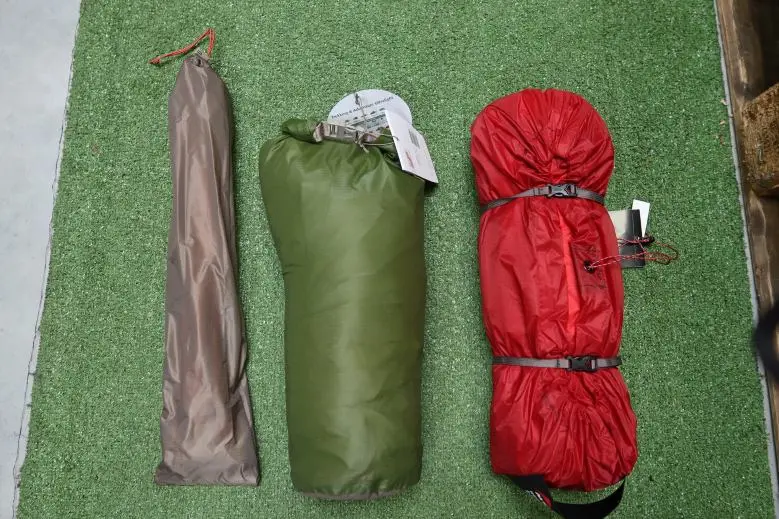
Pitching is quick and simple for both tents, as is taking them down. With the Hogan, I have dried the groundsheet in the morning without removing the poles by lifting the tent onto its side, which can be useful on soaking wet ground. I cannot say for certain that one dries faster than the other, although the Hubba Hubba's thinner fabrics may dry a little better.
I have already discussed doors and porches: both tents have advantages and disadvantages here, although the Hubba Hubba's double entrance is very convenient. One advantage of the Hogan UL is that its double-zip door can open like a window to provide ventilation or a view while remaining sheltered (this appealed to a wildlife photographer, for example).
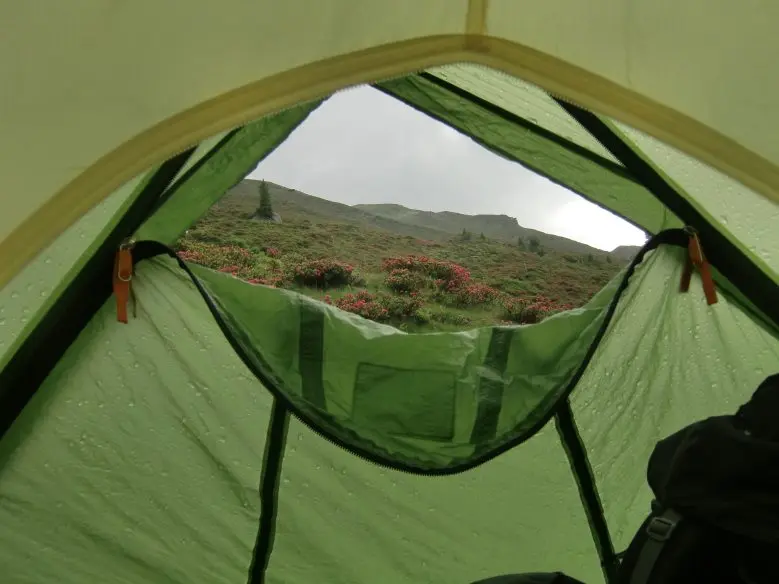
Overall, both tents are easy to handle. It is up to you to decide which layout suits you best.
Conclusion: which tent for which use?
The Vaude Hogan Ultralight is a tent for all conditions and all uses. Wind, rain, cold, rough terrain: it is robust and versatile. Its comfort and practicality are perfectly respectable, though I find them inferior to the Hubba Hubba's. You can take it anywhere and 2 people will be comfortable, although a beginner may find it a little cramped. For very frequent or extended use, it will certainly be tougher and more dependable.
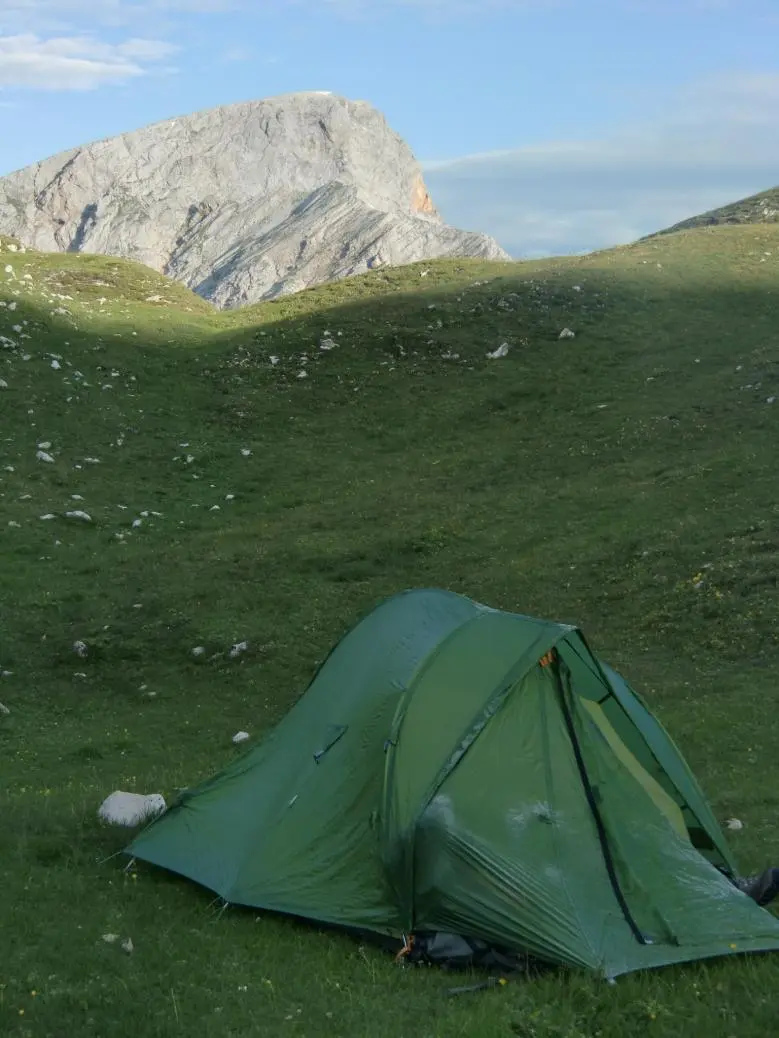
The Hubba Hubba is the tent for relaxing and spending time under cover if needed: an entrance each, comfortable sitting space and room to breathe. However, thinner materials make it more fragile, requiring greater care. Its lifespan will probably be shorter with intensive use, and it is unsuitable for Iceland or severe weather. Consider adding an extra groundsheet and tensioning the guylines if necessary.
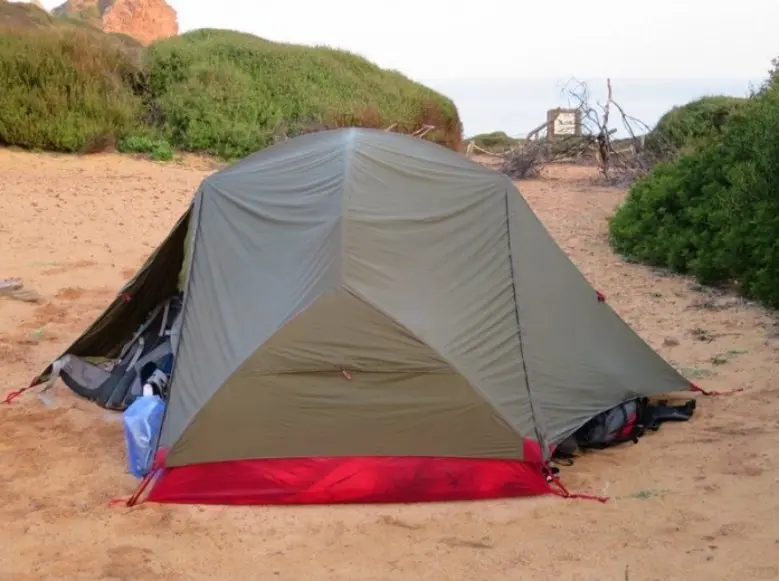
If you hike alone, the advantages of the Hogan Ultralight seem to outweigh those of the Hubba Hubba. For 2 people, there is a trade-off between comfort/practicality and robustness.
Note that the Hubba comes in 1-, 2- and 3-person versions: Hubba, Hubba Hubba and Mutha Hubba. A lighter Hogan version with thinner fabrics is also available: the Hogan SUL. There is also a version pitched flysheet first (with the inner tent pre-attached): the Taurus Ultralight.
Back to contents
 Book: Alexandra David-Néel,
the fearless adventurer
Book: “Voyage d’une parisienne à Lhassa” by Alexandra David-Néel
A quick poll: it is 1924 and you are in the Himalayas, in cold and snow, with almost no food left. Turn left and you descend to a village; turn right and you climb higher, perhaps finding the sources of the Poloung Tsangpo river. What do you do?
Alexandra David Néel thinks it would be a shame to pass through without seeing the sources. It nearly costs her her life.
This anecdote about a Parisian woman in Lhasa illustrates her life rather well: a true adventurer whose appetite for discovery sometimes outweighs her survival instinct.
The author:
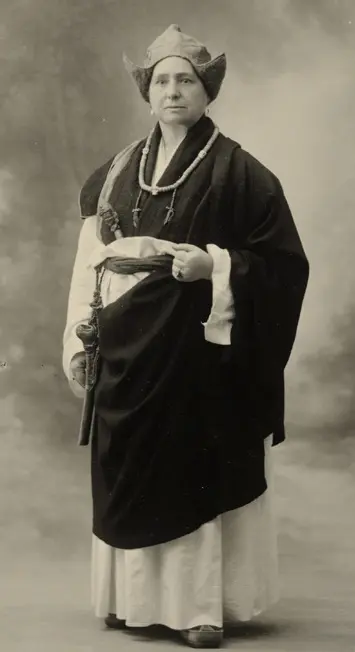
Born in 1868, Alexandra David-Néel is described on Wikipedia as a “French orientalist, Tibetologist, opera singer and feminist, journalist and anarchist, writer and explorer, Freemason and Buddhist.” She became famous less for her short singing career than for her Eastern adventures, and certainly for successfully combining journalistic and literary talent with adventurous daring evident from her youth.
The story:
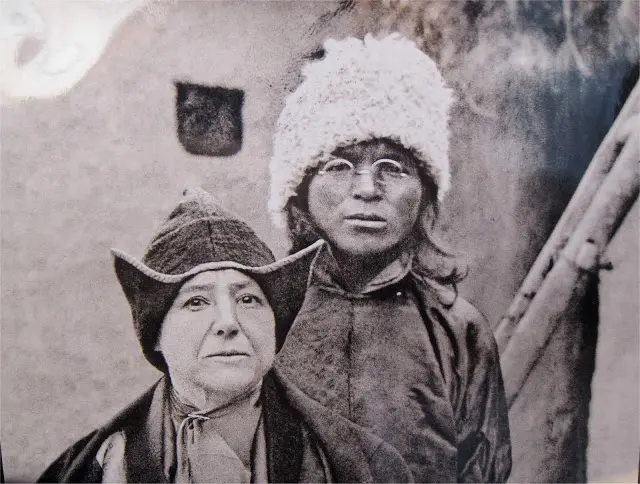
In 1924, Alexandra David-Néel is 56 and has already led an adventurous life, with extensive knowledge of the Indo-Tibetan world.
Accompanied by her future adopted son, the lama Yongden, she decides to reach and enter Lhasa disguised as a Tibetan beggar woman. The city is then closed to foreigners. Yet it is less a final goal than a stage in a long journey. Above all, the book recounts her somewhat extraordinary travels through the Tibetan mountains (and also China and India), facing natural and human dangers with little hesitation. She then visits the “sacred” city incognito, staying for 2 months.
A book of discovery and adventure:
The lively style makes you feel as though you are there. Sometimes you feel cold on her behalf. This fairly short book takes us a long way. We discover a steep, wild natural environment, an ancient civilisation and a strong-minded woman all at once.
There is never a dull moment with Alexandra, and it feels like reading both a historical account and a modern adventure.
Refreshing summer reading.
Alexandra David-Néel: “Voyage d’une parisienne à Lhassa”; publisher: Pocket
Back to contents
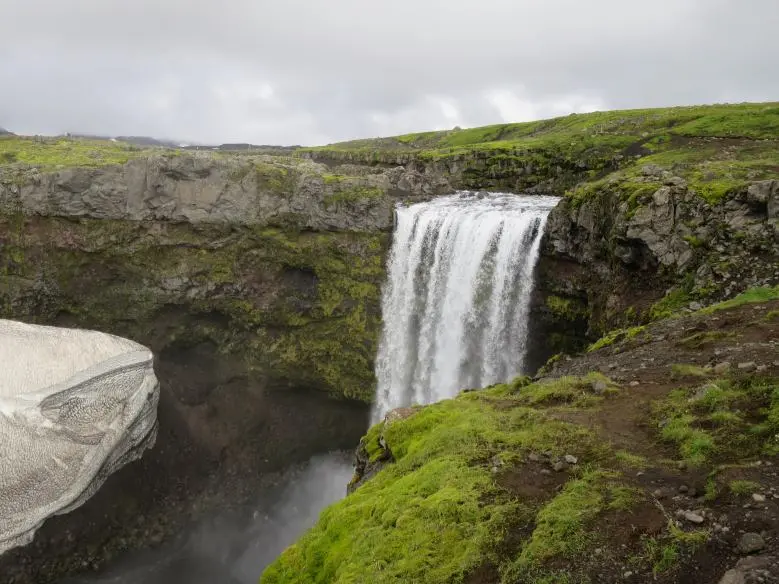 Coming soon: Iceland
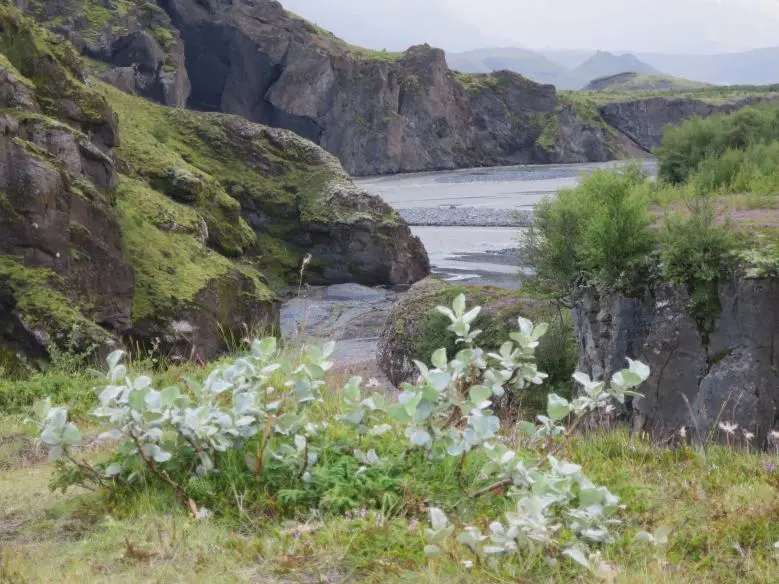
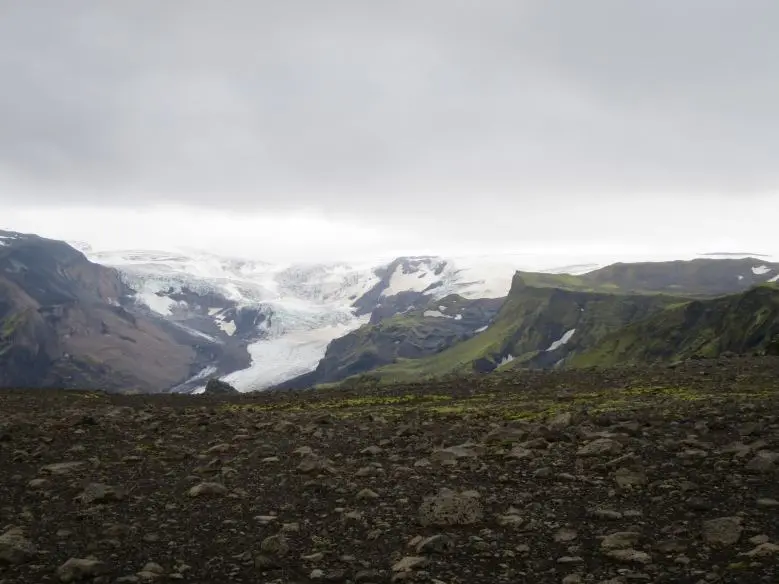
In the next issue, discover the trek from Landmannalaugar to Skogafoss in Iceland.
Subscribe so you do not miss this article!
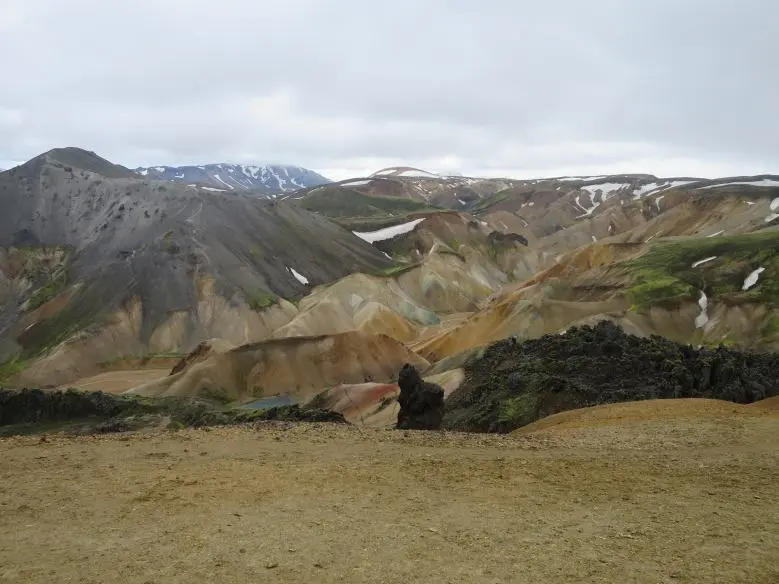
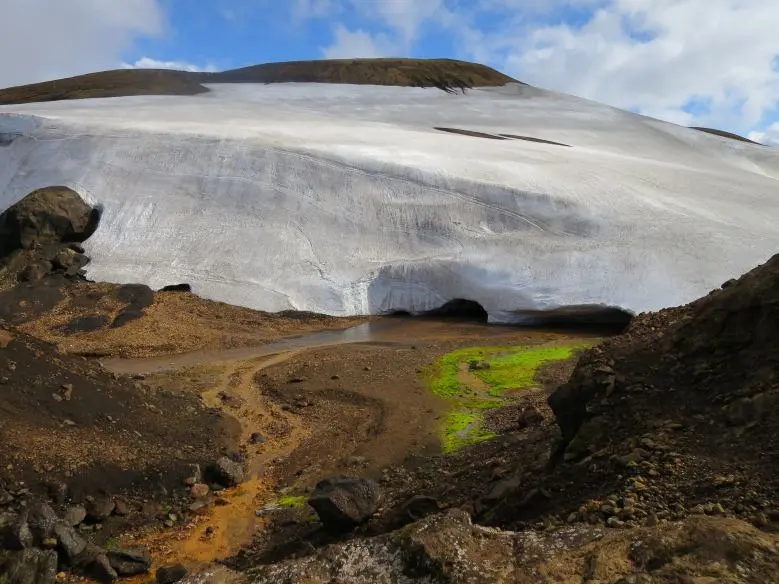
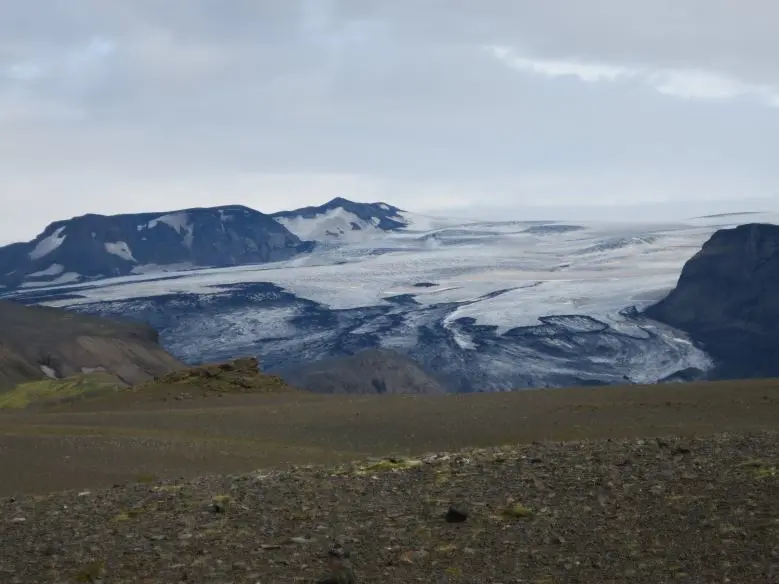
Back to contents
We would like your feedback:
If you have 3 minutes, tell us what you thought of this 5th issue. It will help us improve future issues: Share my feedback
Coming next:
Iceland: the Landmanalaugar trek
Folding versus telescopic poles: a test
Caring for your sleeping bag
Receive RayonRandoZine:
Clear, concise articles:
- Practical advice
- First-hand experiences
- Techniques
- Route guides & destinations
- Hiking and long-distance travel literature...
You will receive 1 free magazine a month for 12 months.
No adverts. No marketing emails.